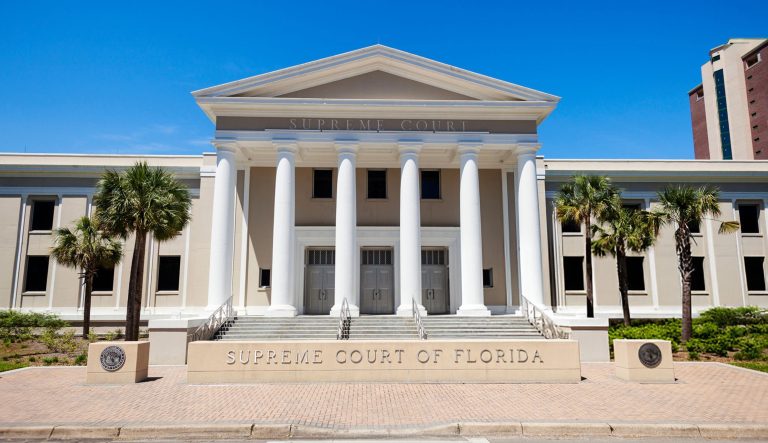

Fla. Justices Give Trial Judges More Dismissal Discretion
Fla. Justices Give Trial Judges More Dismissal Discretion
On July 9, 2026, the Florida Supreme Court resolved a conflict among Florida’s district courts of appeal regarding the standard of appellate review when a trial court dismisses a case for fraud on the court. In Publix Supermarkets, Inc. v. Goga, No. SC2024-0669, the Court rejected the “more stringent” abuse of discretion standard applied by some district courts. The Court quashed the Fourth District’s decision and reinstated the trial court’s order dismissing the plaintiff’s entire complaint with prejudice.
Factual Background
In Goga, the plaintiff slipped on dish soap while shopping at a Publix supermarket. The plaintiff subsequently sued Publix for premises liability, alleging injuries to her neck, back, pelvis, and hip area, and claiming seven months of medical treatment for her spine. She sought damages for medical expenses, pain and suffering, and lost wages.
In discovery responses, the plaintiff claimed she was unable to “lift anything heavy” or “do [physical] activities” such as playing in the pool, nor could she “walk or stand for long periods” or “go places with both [of her] children alone.” At her deposition, she insisted she could not lift her young children, could neither bend at the waist nor run, and claimed a severely limited range of motion as well as difficulty walking.
A private investigator captured video of the plaintiff doing many of these activities, including picking up and carrying her children, bending at the waist as she loaded and unloaded her vehicle, walking with groceries in hand, and even playing in the pool, all without apparent discomfort.
Dismissal, Appeal, and Analysis from the Florida Supreme Court
The trial court granted Publix’s motion to dismiss for fraud on the court, finding by clear and convincing evidence that the plaintiff intentionally and repeatedly lied about her physical limitations. On appeal, the Fourth District Court of Appeal applied a “more stringent abuse of discretion standard.” The district court affirmed the finding of fraud but reversed as to the sanctions, holding that only the pain-and-suffering and lost-wages claims should be dismissed while remanding for reinstatement of the medical expenses claim. The Florida Supreme Court then granted review to resolve the conflict with the Third District’s decision in Willie-Koonce v. Mia. Sunshine Transfer & Tours Corp., 233 So. 3d 1271 (Fla. 3d DCA 2017).
Rejecting the heightened standard applied by the Fourth District Court of Appeal, the Court adopted the framework from Pro Choice Remediation, Inc. v. Old Dominion Ins. Co., 400 So. 3d 789 (Fla. 1st DCA 2024), applying traditional standards separately to each component: (1) factual findings regarding the nature and extent of a party’s deception are reviewed for competent, substantial evidence; (2) the legal conclusion that the conduct constitutes fraud on the court is reviewed de novo, with the appropriate question of whether the deceit was “so egregious and pervasive that it amounted to an intentional scheme to undermine the impartial adjudication of the case”; and (3) the choice of sanction is reviewed for traditional abuse of discretion. The Court emphasized this standard “cuts both ways,” meaning that a trial court’s decision not to dismiss despite finding pervasive fraud could also constitute an abuse of discretion.
Applying the adopted framework to the facts of Goga, the Court found all three components satisfied. The trial court’s factual findings that the plaintiff intentionally and repeatedly lied about her physical limitations were supported by competent, substantial evidence, including the surveillance videos and plaintiff’s testimony at an evidentiary hearing. Under de novo review, the Court concluded that the plaintiff’s pervasive lying “comprehensively infected the integrity of the action.” Finally, the trial court did not abuse its discretion in dismissing the entire action, as the Court could not say that no reasonable judge would have imposed the sanction of dismissal.
Implications for Future Cases
The Court’s decision in Goga could have significant effects on trial court sanctions practice throughout Florida. By replacing the “more stringent” standard with traditional abuse of discretion review, the Court has given trial judges broader and more secure discretion to impose dismissal as a sanction when fraud on the court is established. Under the prior regime, trial courts that dismissed cases for fraud faced heightened appellate scrutiny that effectively invited district courts to second-guess the sanction and substitute their own judgment. Now, so long as a trial court’s factual findings are supported by competent, substantial evidence and its legal conclusion of fraud is correct, its choice of sanction, including the ultimate sanction of dismissal with prejudice, will be reviewed under a highly deferential standard that asks only whether no reasonable judge would have imposed the same.
This shift could be particularly consequential in personal injury litigation, where plaintiffs who exaggerate or fabricate injuries during discovery are a common target of fraud-on-the-court motions. Slip-and-fall cases, automobile accident claims, workers’ compensation disputes, and insurance fraud cases could all see an increase in defense motions for dismissal, now that trial courts can act with greater confidence that their sanctions will survive appeal.
The decision also underlines the value of surveillance evidence during discovery. Well-documented fraud can lead to complete dismissal of an action. Importantly, the Court’s observation that the standard “cuts both ways” means that a trial court that finds pervasive fraud but declines to dismiss could itself face reversal, potentially creating a new source of appellate challenges where defense attorneys argue that lesser sanctions were unreasonable in the face of egregious misconduct.
The implications of the Goga decision could also extend well beyond dismissals imposed against plaintiffs. Although Goga arose in the context of a plaintiff’s fraud, the Court’s reasoning is not limited to that posture. The traditional abuse of discretion standard could apply equally to sanctions imposed against defendants, including striking of affirmative defenses, entry of default judgments, or adverse inference instructions levied for discovery violations or litigation misconduct. By confirming that appellate courts should not apply a heightened or “narrowed” standard when reviewing severe sanctions for fraud on the court, the decision effectively grants greater deference to all trial court sanctions in this context, regardless of which party is sanctioned.
Defendants who engage in fraudulent discovery conduct, conceal evidence, or present fabricated testimony now face the same risk: a trial court that imposes the harshest available sanction will be reviewed only for whether no reasonable judge would have done the same. This broader reach means the decision may influence any civil proceeding where a party’s litigation conduct is called into question. All appellants must now contend with the traditional abuse of discretion standard.
The resolution of the inter-district conflict is itself significant. Following the decision from the Florida Supreme Court, all six district courts of appeal now operate under a single, uniform standard of review when appealing sanctions. The district courts will no longer have license to apply a “more stringent” standard that functioned as an invitation to reweigh the evidence. The net effect is a legal environment that is more deferential to trial court judgment on sanctions, whether the sanctioned party is a plaintiff or a defendant.
Practical Guidance for Florida Practitioners
Florida litigators should impress upon their clients that dishonesty in litigation now carries the realistic risk of case-ending consequences. Trial courts have been empowered to impose the ultimate sanction of dismissal or its equivalent, and appellate courts will likely defer to that choice so long as it is not wholly unreasonable. Counsel should ensure that clients understand from the outset that sworn statements will be scrutinized and that any material inconsistency between those statements and the client’s actual conduct could be treated as fraud on the court.
Attorneys should also be proactive about correcting the record when inaccuracies come to light. Supplementing interrogatory answers, filing deposition errata, or otherwise addressing inconsistencies early may prevent a court from concluding that the fraud “permeated the entire proceeding.” Conversely, practitioners seeking sanctions must ensure the evidentiary record is well-developed with clear and convincing evidence. Surveillance footage, documentation of contradictions, and social media records should be preserved meticulously and presented strategically at evidentiary hearings.
Practitioners should also consider whether Florida courts will extend Goga’s reasoning beyond fraud-on-the-court dismissals to other sanctions contexts. The Court’s central logic that traditional standards of review are sufficient and that specialized heightened standards produce unpredictable, inconsistent results is not inherently limited to fraud on the court. That reasoning could have persuasive force wherever appellate courts have historically applied heightened scrutiny to trial court sanctions. Sanctions for discovery violations, including orders compelling disclosure, striking pleadings, or entering defaults for failure to comply with discovery, have sometimes been subjected to closer appellate scrutiny when the sanction is severe. Under Goga’s logic, courts may conclude that the traditional abuse of discretion standard is equally appropriate in that context, making it harder for sanctioned parties to obtain reversal on appeal.
The Goga decision may also influence how courts review sanctions in contempt proceedings, where trial courts punish parties for willful disobedience of court orders – a context that, like fraud on the court, involves a trial court’s assessment of a party’s intentional misconduct. Beyond these statutory and rule-based sanctions, Goga could reshape appellate review of a trial court’s inherent authority to sanction litigants for bad-faith conduct, including the imposition of attorney’s fees, adverse inference instructions, or preclusion of evidence as a sanction for spoliation. In each of these areas, the same tension exists between respecting trial court discretion and protecting parties from disproportionate punishment. Goga decisively resolves that tension in favor of deference to the trial court. Practitioners should anticipate that opposing counsel may invoke Goga to support the imposition of severe sanctions with reduced fear of appellate reversal. Whether seeking or defending against possible sanctions, attorneys should be prepared that the initial ruling from the trial court will carry greater weight moving forward.
This article first appeared in Law360 on August 10, 2026 and is republished here with permission from the publication.