Florida’s 4th DCA Underlines Importance of Rules Governing Depositions of Designated Corporate Representatives

05.02.13 | Permalink

Posted by: Timothy N. Bench

In a recent decision, a Florida appellate court discussed why we have rules allowing for corporate entities to designate corporate representatives to speak for them, and the implications of failing to utilize the designated procedures properly. In Carriage Hills Condominium, Inc. v. JBH Roofing & Constructors, Inc., --- So. 3d ---, 2013 WL 1136399, 38 Fla. Law Weekly D643 (Fla. 4th DCA, March 20, 2013), the court addressed the appeal of a summary judgment granted by a trial court following the deposition of an employee of a corporation.                                                                               

Carriage Hills, a condominium association, through its board of directors, hired JBH Roofing to perform building repairs necessitated by Hurricane Wilma pursuant to a contract which obligated JBH to perform only work approved by Carriage Hills’ public adjuster, and to accept payments approved by and received from Carriage Hills’ insurer. Less than a year later, Carriage Hills had terminated JBH’s contract and JBH sued alleging breach of contract and other related claims. The breaches alleged by JBH included (a) failure to pay for repairs approved by the carrier; (b) failure to diligently present claims for loss to the carrier; and (c) retention of other roofing contractors to perform work that should have gone to JBH pursuant to the contract.

Carriage Hills answered and asserted affirmative defenses alleging, among other things, that (1) the contract was “executed without Board approval”; (2) that it had already paid JBH in full for all work performed; (3) that JBH failed to mitigate damages; and (4) that JBH failed to perform its repairs satisfactorily or with due diligence.

JBH noticed for deposition the “Corporate Representative of Carriage Hills Condo with the most knowledge of the allegations contained in the complaint.” The notice made no reference to any particular issue(s) to be addressed, or to Carriage Hills' affirmative defenses and counterclaims.

Carriage Hills tendered Ms. Diane Foley, who in her then-capacity as President of the association, executed the JBH contract and was apparently the person with “the most knowledge” of the allegations in JBH’s complaint.

After testifying that she was authorized to execute the contract, Ms. Foley was repeatedly asked whether, in her “opinion,” contentions within the parties' pleadings were accurate. When asked whether she “believed” JBH had breached the contract, she responded, “In my layman opinion, no.” She testified that she was “not aware” of any unauthorized work performed, and that she “believed” that JBH completed all the tasks it was authorized to do up to the time of termination. She also did not believe JBH's work was defective.

Armed with this testimony, JBH filed its Motion for Summary Judgment, in response to which Carriage Hills filed affidavits of another former president of the association and of its treasurer, in which it was asserted that JBH performed “substandard work with respect to the roof systems”, “submitted duplicate charges”, and “conducted unauthorized work, including work that was not paid for [by the carrier].” The affiants further asserted that due to JBH's shoddy repair work, Carriage Hills was forced to retain other roofing contractors to fix “water leaks and problems encountered with the roof system,” and that JBH was paid all of the funds approved by -- and received from -- the insurer.

The trial court held that Ms. Foley, as its corporate representative, was “Carriage Hills,” and that her testimony was therefore binding on Carriage Hills. Accordingly, it struck the two affidavits, reasoning that “[i]n situations where the non-movant in a motion for summary judgment submits an affidavit which directly contradicts an earlier deposition . . . , courts may disregard the later affidavit.” Based upon Ms. Foley’s deposition testimony, the trial court granted summary judgment to JBH, and Carriage Hills appealed.

On appeal, Florida’s 4th District Court of Appeals addressed the proper procedure for noticing and taking the deposition of a designated corporate representative in Florida. Florida Rule of Civil Procedure 1.310(b)(6), which governs depositions of designated corporate representatives, requires the party seeking the deposition to describe, with reasonable particularity, the matters for examination. This allows the corporate entity to select an individual or individuals able to testify on its behalf regarding the designated subjects. The Rule does not require that the person with “the most knowledge” regarding anything be produced. In fact, the court pointed out that the “knowledge” as to which the designated representative(s) are produced to testify is that of the corporation, and not the personal knowledge of the selected individual(s). The deponent needn’t have any relevant personal knowledge at all.

Against this backdrop, the appellate court noted that Ms. Foley had not been properly noticed as a corporate representative, since the notice failed to designate specific areas of inquiry, instead asking for the person “with the most knowledge’ regarding the allegations in the complaint. And JBH got exactly what it asked for as a result – a deponent with personal knowledge of relevant facts but not a person who would testify to the knowledge and litigation positions of Carriage Hills. To add insult to injury, the deposition was also not properly conducted, in that Ms. Foley was repeatedly asked about her personal opinions rather than the positions of the corporation. The result was that Ms. Foley’s testimony did not directly contradict the affidavits subsequently submitted by Carriage Hills, and the appellate court held that the trial court had acted improperly when it struck them and entered summary judgment based on Ms. Foley’s testimony. The summary judgment was therefore reversed and the case remanded to the trial court for further proceedings.

It has, unfortunately, become a common practice in Florida for notices for corporate representative depositions to request the “person or persons with the most knowledge” regarding designated subject areas or, most broadly, “the issues set forth in the pleadings.” The Carriage Hills decision serves as an important reminder of how failure to properly notice and conduct a corporate representative deposition can severely diminish the usefulness of the resulting deposition and the streamlining purpose of Rule 1.310(b)(6). Conversely, practitioners receiving such notices should consider filing objections and/or objecting on the record to such improper language.

Bookmark and Share


Update Regarding Florida’s Proposed Product Liability Instructions

04.08.13 | Permalink

Posted by: Steven I. Klein

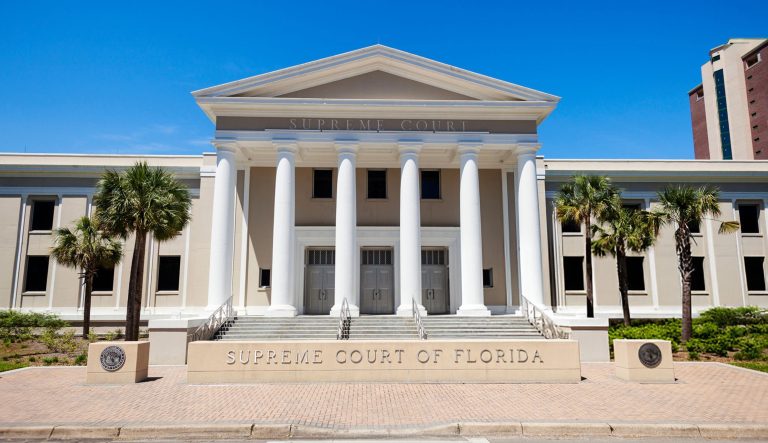
On May 17, 2012, The Supreme Court of Florida issued its opinion concerning proposed new Standard Jury Instructions for product liability cases. The Court preliminarily approved several of the proposed instructions, but rejected a number of instructions and directed the Committee to revise the proposed instructions. Among the rejected proposed instructions were an instruction covering strict which eliminated the differences between design and manufacturing defects and eliminated the risk utility test; an instruction on inferences of defect; and an instruction on crashworthiness. 

On February 1, 2013, the Committee submitted revised proposed instructions for comment. The comment period ended on March 1, 2013. The changes contained in the revised instructions are far less drastic than the initial proposed revisions. The strict liability instruction essentially mirrors current instruction PL 5 and maintains a distinction between design defects and manufacturing defects.  The revised proposed instruction also continues to list both the consumer expectations and risk/benefit tests. However, the Committee notes explain that pending further development in the law, the Committee has not taken a position on whether the risk/benefit test and consumer expectation test should be given together or in the alternative. The Committee also did not take a position on whether the risk/benefit test is a standard for proving a defect or an affirmative defense. Accordingly, the proposed instructions include the risk/benefit test in the instruction for design defect as well as in a separate defense instruction. The proposed instructions make clear that the jury should not be instructed on the risk/benefit test both as a defect standard and a defense.

Another change included in the revised proposed instructions is a specific set of negligence based product liability instructions. Under the existing product liability instructions, the parties were forced to shoehorn products liability concepts into the standard instructions for general negligence. 

Further, due to the Legislature’s statutory overruling of D’Amario v. Ford Motor Co., 806 So.2d 424 (Fla. 2001), the Committee scrapped the very wordy and unbalanced crashworthiness instruction. The revised proposed instructions now only include a short statement of crashworthiness in the summary of claims and explain that the no special product liability instructions should be given. Rather, the Committee Notes for the instruction explain that the standard instructions applicable in other cases should be given in crashworthiness cases.

The Committee will be submitting the revised proposed rule to the Florida Supreme Court. The Court will then open a period for additional comment on the proposed rules before issuing its opinion on the proposal.

Check back with us for updates.

Bookmark and Share


Proposed Florida Law H.B. 587 Seeks Fairness in Plaintiff Recoveries on Claims for Medical Expenses

02.26.13 | Permalink

Posted by: Brian J. Baggot and Samantha Crawford Duke

On February 1, 2013, Florida Representative, Dave Hood (R-Daytona Beach), filed H.B. 587,[1] a bill proposing to add Section 768.755 to the Florida Statutes. If passed, this statute would at last bring fairness and accuracy to the calculation of medical special damages that a plaintiff may publish to the jury at trial.  This would alter current Florida case law which holds that evidence of the gross amount of medical expenses is admissible even if the health care provider accepted a reduced payment pursuant to a contractual discount with the plaintiff’s health insurer.

For example in Nationwide Mutual Fire Insurance Co. v. Harrell,[2] the plaintiff introduced evidence at trial of the gross amount of her medical bills even though the medical provider had accepted a discounted figure from her health insurer as payment-in-full. The defendant appealed, arguing that the admission of the amount charged rather than the amount paid misled the jury as to the true amount of the medical special damages. In its appeal, the defendant cited several precedent cases in which plaintiffs were prohibited from asking the jury to award the gross amount of medical bills when the treater had accepted a lower payment from Medicare on behalf of such plaintiffs. The First District Court of Appeal disagreed, distinguishing the scenario in which the reduced medical bills resulted from Medicare or other government benefit programs as opposed to contractual discounts negotiated by private insurers.

The Nationwide Court found that in situations where the plaintiff “earned (or paid for)” the benefit of reduced health care costs through the payment of private insurance premiums, she was entitled to present evidence of the gross amount of medical expenses charged.[3]  The court cited the “well-settled rule of damages” that “where the tortfeasor did not contribute to the payment of the premiums of such insurance, [he] should not benefit from the expenditures made by the injured party in procuring the insurance coverage.”  This rationale was taken even further in Durse v. Henn,[4] where the Fourth District Court of Appeal allowed the plaintiff to present evidence of his gross medical bills - even though he had no health insurance - because he “earned in some way” the benefit of reduced charges by negotiating a compromise of the amount billed by the medical care provider. 

These two cases fail to account for the inherent fiction of modern healthcare billing.  Today, gross hospital bills are not a truthful indicator of the real costs of the medical services provided. The recent debate over the Patient Protection and Affordable Care Act exposed how medical care providers fabricate vastly inflated bills for their services, disconnected from any real market forces.[5] In an unrelated case, the Florida Fourth DCA discussed this inherent perfidy of modern medical billing:

“[A] hospital’s cost to provide a service no longer bears much relationship to what it charges, but reimbursement rates from third party payors give hospitals an incentive to set their usual charges at an artificially high amount, from which discounts are negotiated; cost-shifting results in discriminatorily high charges to uninsured patients, in that every patient is billed at full charges, but only the uninsured are expected to pay those amounts. As a result, actual charges are not instructive on what is reasonable. [….]”

See Colombia Hospital v. Hasson.[6] The Nationwide and Durse opinions actually encourage this dysfunctional system by allowing false evidence of phantom medical expenses for which the medical provider never required payment. In fact, considering the observation in Columbia Hospital above, the Durse holding could actually discourage an injured person from presenting his health insurance to the hospital in order to maximize the bill in hopes of a higher personal injury award. 

The primary duty of the courts is the search for the truth in order to give justice to the litigants. See Ward v. Ochoa.[7] A rule of law permitting admissibility of fictional damages subverts the very purpose of the civil jury system.  For example, assume a hypothetical in which a pain management doctor provided the plaintiff a series of post-accident trigger point injections at an invoiced cost of $900 per injection. Assume also that the pain doctor had waived subrogation rights and agreed to accept just $150 per injection as payment-in-full based on the cost he negotiated in a preexisting contract with plaintiff’s private health insurer.  As decided in Nationwide, the plaintiff in this hypothetical could nonetheless present false evidence to the jury that her costs were $900 per injection. Nationwide would also permit this plaintiff to present the fictional $900 per injection in calculating future medical care costs despite full knowledge the amount would never be expected by her doctor. 

If the jury awards her that gross amount however, Florida law requires the trial court to deduct the $750 per-injection “discount” from the amount awarded by the jury.[8] This post-verdict setoff is of little consolation to the defendant. Plaintiffs’ lawyers obviously seek to publicize the maximum possible economic damages to the jury based on the very reasonable presumption that they will correlate larger economic losses with a higher severity of injury.[9] The current “setoff” approach is designed only to prevent a windfall on past medical expenses never paid by the plaintiff. The approach fails however, to appreciate that juries calculate awards for pain and suffering and other noneconomic damages based upon the amount of the medical bills submitted by the plaintiff for reimbursement. Thus, any equity worked by the post-verdict setoff will have already been erased by an exaggerated pain and suffering award stemming from the inflated bills. 

If passed, H.B. 587 will change this scenario. The Bill proposes that if the medical provider’s charges have been satisfied, “the actual amounts remitted to the provider are the maximum amounts recoverable.” In such circumstances, the Bill requires that any difference between the amounts originally billed by the provider and the actual amounts accepted by the provider as payment-in-full “are not recoverable or admissible into evidence.” Therefore, in the above hypothetical, the plaintiff would be permitted only to present evidence that the trigger point injections cost $150 per shot. The Bill further proposes that if there remains an outstanding balance or if the claimant alleges the need for future medical services, the maximum amounts recoverable are the amounts customarily accepted - as opposed to billed - in payment for such services by providers in the same geographic area.  

The current state of Florida law reflects an antiquated notion that the gross amount of medical bills are derived from a rational, market-driven calculation of the true costs of the services provided. This is simply no longer the case. Hopefully, H.B. 587 will bring a fair and accurate statutory approach for jury calculations of medical special damages. In the meantime, RKC lawyers continue to use other strategies including aggressive non-party discovery of the billing policies of medical providers in order to ensure the evidence reflects the true costs of


[2] 53 So. 3d 1084 (Fla. 1st DCA 2010).

[3] The Nationwide Court’s basis for distinguishing the precedent cases on such grounds was tenuous at best. Even those qualifying for so-called “free” Medicare Part A coverage would have earned it via payroll taxes while either they or their spouse was working. See the Federal Insurance Contributions Act, 26 U.S.C. Ch. 21.

[4] 68 So. 3d 271 (Fla. 4th DCA 2011).

[5] See Brill, Steven. “Bitter Pill: Why Medical Bills Are Killing Us.” Time Magazine. 20 Feb. 2013. Brill’s study of modern hospital billing found that “no hospital’s prices are consistent with those of any other [….] nor based on anything objective like cost.” Brill cited findings in economic studies of the medical marketplace showing:

[I]n healthcare there is little of the price sensitivity found in conventional marketplaces [….]. If you were in pain or in danger of dying, would you turn down treatment at a price 5% or 20% higher than the price you might have expected? 

When he polled hospital officials to explain exorbitant prices on specific patient bills, Brill received responses such as: “Those are not our real rates,” or that the figures were “only used internally in certain cases, but most people never pay those prices.” 

[6]  33 So. 3d 148, 150 n.3 (Fla. 4th DCA 2010)

[7] 284 So.2d 385, 387 (Fla. 1973). See also, Morgan Intern. Realty, Inc. v. Dade Underwriters' Ins. Agency, Inc., 571 So.2d 52, 53 (Fla. 3rd DCA 1990) (Noting that in its “search for the truth,” the jury “has a perfect right to [….] ask questions [….] in developing the truth of the controversy”); see also Fla. Std. Jury Instr. (Civ.) 101.2; Oath Of Juror After Voir Dire (requiring the juror to “solemnly swear or affirm” to “well and truly try [the] case” and render a  “true verdict”).

[8] See Goble v. Frohman, 901 So. 2d 830 (Fla. 2005) in which the Florida Supreme Court determined that contractual discounts negotiated by the plaintiff’s HMO and “written off” by the plaintiff’s medical providers were deemed collateral sources to be setoff against the awarded damages. The Florida Supreme Court did not address the issue of whether this setoff was to occur before the medical bills were presented to the jury or, post-verdict by the trial court. In the underlying appellate case however, the Second Florida District Court of Appeal held that the setoff was to occur post-verdict, Goble v. Frohman, 848 So. 2d 406 (Fla. 2d DCA 2003), a procedure followed in both Nationwide and Durst.

[9] See Ronen Avraham, Putting a Price on Pain-and-Suffering Damages: A Critique of the Current Approaches and a Preliminary Proposal for Change, 100 Nw. U. L. Rev. 87, 112 (2006). Indeed, recent research has shown that jurors’ subjective assessments of the severity of injury are perhaps the best predictor of pain and suffering awards. See Roselle L. Wissler et al., Decisionmaking About General Damages: A Comparison of Jurors, Judges and Lawyers, 98 Mich. L. Rev. 751, 760-761 (1999).

Bookmark and Share


Recent Updates

05.02.13  Florida’s 4th DCA Underlines Importance of Rules Governing Depositions of Designated Corporate Representatives  Read Article >>

04.08.13  Update Regarding Florida’s Proposed Product Liability Instructions  Read Article >>

02.26.13  Proposed Florida Law H.B. 587 Seeks Fairness in Plaintiff Recoveries on Claims for Medical Expenses  Read Article >>

01.03.13  Using Cell Phone Records In Accident Cases  Read Article >>

11.27.12  Florida Supreme Court To Decide Appropriate Procedure For Litigating Wrongful Death Claims That Arise During Pendency of Personal Injury Action  Read Article >>

view all

 
© Rumberger Kirk & Caldwell Attorneys At Law Web site hosted on the FirmWise platform