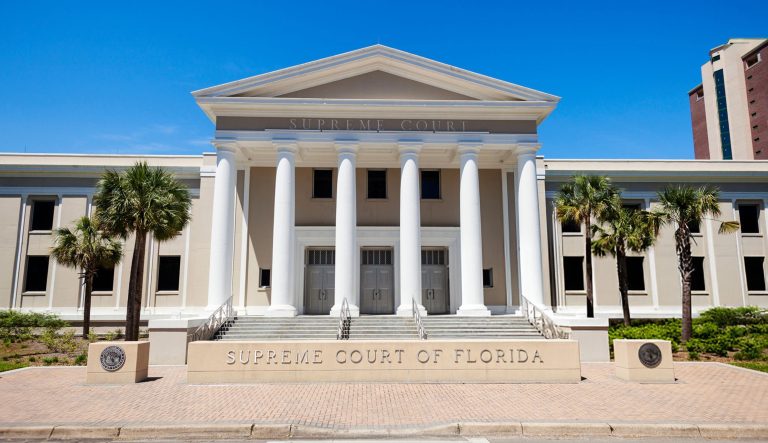

One-Sided Game: Florida Supreme Court Limits Defense Role in Punitive Damages Motions
One-Sided Game: Florida Supreme Court Limits Defense Role in Punitive Damages Motions
In Perlmutter v. Federal Ins. Co., No. SC2024-0058, 2026 WL 1689765 (Fla. June 11, 2026), the Supreme Court of Florida unanimously rejected the decision of the Florida 4th District Court of Appeal In Perlmutter v. Federal Ins. Co., 376 So.3d 24 (Fla. 4th DCA 2023). The specific issue concerned plaintiff’s burden in showing entitlement to assert a claim sounding in punitive damages.
Fla. Stat. sec. 768.72 et seq. outlines the requirements for asserting a claim for punitive damages. Specifically, sec. 768.72(1) provides in pertinent part:
“In any civil action, no claim for punitive damages shall be permitted unless there is a reasonable showing by evidence in the record or proffered by the claimant which would provide a reasonable basis for recovery of such damages. The claimant may move to amend her or his complaint to assert a claim for punitive damages as allowed by the rules of civil procedure.”
Background
The case arose as a dispute between neighbors, leading up to one party allegedly surreptitiously obtaining the Perlmutters’ DNA, and using this data to support false accusations. The Perlmutters ultimately filed a motion to add a claim sounding in punitive damages, which was granted by the trial court.
The 4th DCA, hearing the appeal en banc, reversed the trial court’s decision to allow the addition of the punitive damages claim. The DCA held:
- In deciding such a motion, a trial court must consider the evidentiary showings of all parties;
- The trial court must make a preliminary determination of whether a reasonable jury could find by clear and convincing evidence that punitive damages were warranted; but
- In making such a determination, the trial court should not itself decide whether the evidence is clear and convincing, nor should it weigh evidence nor determine witness credibility. (pp. 9-10)
The 4th DCA reversed the trial court’s order permitting the assertion of the punitive damages claim, and certified that its opinion conflicted with opinions of other District Courts of Appeal. It also submitted a question of great public importance on the issue of whether the trial court was required to determine that a reasonable jury could find, by clear and convincing evidence, that punitive damages were warranted. (p. 11)
The Supreme Court’s Decision
As stated above, the Supreme Court quashed the 4th DCA’s decision, enunciated the standards to be followed by trial courts in determining motions to add a punitive damages claim, and remanded the case. The Court held:
- In applying the punitive damages statute to such motions, a court may only consider the showing made by plaintiffs. It should not entertain any counter-showing from defendants. In reaching this determination, the Court pointed out that the statute did not tie the inquiry at the motion practice stage to any trial-level standard of proof. It noted that the punitive damages provision of the Florida Nursing Home Statute, Fla. Stat. sec. 400.0237, contained a specific provision for submission of evidence by both parties, and that it would have been easy for the legislature to have inserted such a provision into sec. 768.72 et seq. if it had desired.
- The test for deciding evidentiary sufficiency on a motion to add a punitive damages claim is whether a reasonable person could conclude, based on the plaintiff’s evidence, that the defendant committed intentional misconduct or gross negligence, as defined in Fla. Stat. sec. 768.72(2).
- If punitive damages are sought against an employer under a vicarious liability theory under Fla. Stat. Sec. 768.72(3), the Court must ensure that plaintiff’s evidence satisfies the criteria that the employer itself committed the actions giving rise to the claim, or condoned or ratified any such act on the part of its employee.
- The trial court must consider any such motion “…in the context of the underlying claims…” as any such claim is necessarily dependent upon the existence of the underlying claim.
- The trial court should not apply the “clear and convincing evidence” standard of proof. (pp. 13-14)
The Perlmutter court avoided being overly specific in its discussions of what measure of proof would or would not satisfy the “reasonable showing” requirements of sec. 768.72. Referring to Fla. R. Civ. P. 1.110(b)(2) (“…a short and plain statement of the ultimate facts…”), the Court stated that sec. 768.72(1) “…compliments that standard in the punitive damages context by requiring the claimant to show that there is a reasonable evidentiary basis underlying the ultimate facts that it seeks to plead.” (p. 21)
Where This Leaves Us
The decision by the Court was obviously extremely pleasing to the plaintiffs’ bar, while disappointing to those involved in defending civil cases in Florida. However, in reviewing the punitive damages cases arising in Florida over the last several years, it becomes apparent that the rationale of the recent 4th DCA cases was rather different than that that utilized by other District Courts of Appeal. The Supreme Court’s opinion in Perlmutter alludes to the distinctions between the 4th DCA cases, and those of other Florida appellate courts. Indeed, the Court referred to several of these cases from other DCAs with approval.
The other Florida District Courts of Appeal have consistently rejected attempts by the plaintiffs’ bar to inject punitive damages claims in cases in which the requisite standard of conduct has not met the statutory criteria. If these courts maintain the practice of closely analyzing punitive damages claims, it is unclear if Florida will experience any significant “rising tide” of punitive damages claims after Perlmutter. That said, the defense bar must be cognizant that plaintiffs’ counsel are always on the alert for ways to advance means of greater recovery for their clients, and in a given case, a claim for punitive damages could be extremely helpful to them.
One primary issue with this decision is that it deprives the defense of any meaningful role in contesting an attempt to add a claim sounding in punitive damages. A review of punitive damages claims arising in Florida over the last several years shows that trial courts have been extremely willing to allow punitive damages claims to be added to lawsuits. As stated, this willingness has not extended to the several District Courts of Appeal. The statutory provisions have not changed. Even so, defense counsel must maintain increased vigilance to spot early on those cases which have the potential to give rise to punitive damages clams.